
EAST GLASGOW CHURCH SAFEGUARDING POLICY
Policy created using the Thirtyone:eight Model Safeguarding Template
January 2026 Contents:
Section 1: Details of the organisation Section
2: Governance and Leadership Section
3: Prevention
Understanding abuse
Positions of Trust
Safer recruitment
Safeguarding training
Practice Guidelines
Management of workers- Codes of conduct
Section 4: Partnership working Section
5: Responding to allegations of abuse
Detailed procedures when there is a concern about a child
Detailed procedure when there is a concern about an adult at risk
Allegations of abuse against a person who works with children/young people
Allegations of abuse against a person who works with adults with care and support needs
Section 6:
Wellbeing Support and Pastoral care
Working with those who many pose a risk
Appendix 1: Safeguarding statement
Appendix 2: Things to consider
Appendix 3: Useful numbers
Appendix 4: Code of Conduct
Appendix 5: Additional forms
Policy created using the Thirtyone:eight Model Safeguarding Template
SECTION 1: DETAILS OF THE ORGANISATION
1.1 Organisational details EAST Glasgow church is led by Tim Scoular, who is supported by a wider ministry team and board of Trustees. In addition to staff, adults are involved in children’s and youth work on a voluntary basis. A Safer Recruitment Process (see later in document) is followed before the appointment of all leaders responsible for the delivery of children’s and youth work or any work involving vulnerable adults; this includes a PVG check, references and safeguarding induction. We run various ministries involving children and vulnerable adults, including but not limited to Sunday services, children and youth ministries, regular midweek groups and more specific community ministries.
NAME OF ORGANISATION: EAST Glasgow church
MAILING ADDRESS: 13 Olympia Street, Bridgeton, G40 3TA
SAFEGUARDING EMAIL ADDRESS: safeguarding@eastglasgow.church
SENIOR LEADER (PASTOR): Timothy Scoular tim@eastglasgow.church
WEBSITE ADDRESS: www.eastglasgow.church
SAFEGUARDING OFFICER : Clare Finbow
SAFEGUARDING TRUSTEE: Oluwatobi Adeagbo
SAFEGUARDING SUPPORT ORGANISATION: Thirtyone:eight (03030031111)
CHARITY NUMBER: SC054404
MEMBERSHIP OF DENOMINATION:
Anglican Convocation in Europe (ACE)
SAFEGUARDING LEAD FOR ACE:
Jenny Townsend jenny.townsend@aceanglicans.org 07964 847 968
INSURANCE COMPANY: Ansvar Insurance, Church Fellowship Connect (Expires 17/11/26)
Policy created using the Thirtyone:eight Model Safeguarding Template
SECTION 2: GOVERNANCE AND LEADERSHIP
Our Commitment
As Trustees we recognise the need to provide a safe and caring environment for children, young people and adults. We acknowledge that children, young people and adults can be the victims of physical, sexual and emotional abuse, and neglect. We accept the UN Universal Declaration of Human Rights and the International Covenant of Human Rights, which states that everyone is entitled to “all the rights and freedoms set forth therein, without distinction of any kind, such as race, colour, sex, language, religion, political or other opinion, national or social origin, property, birth or other status”. We also concur with the Convention on the Rights of the Child which states that children should be able to develop their full potential, free from hunger and want, neglect and abuse. They have a right to be protected from “all forms of physical or mental violence, injury or abuse, neglect or negligent treatment or exploitation, including sexual abuse, while in the care of parent(s), legal guardian(s), or any other person who has care of the child.” As Trustees we have therefore adopted the procedures set out in this safeguarding policy in accordance with statutory guidance. We are committed to build constructive links with statutory and voluntary agencies involved in safeguarding. The policy and any attached practice guidelines are based on the ten safeguarding standards published by Thirtyone:eight.
Governance
East’s Board of Trustees is appointed to have independent authority and legal responsibility. This includes having a critical role in decision making and compliance as well as setting the values, standards and behaviours of the organisation. The standards and behaviours may be referred to as the culture of the organisation or “the way we do things around here”. Culture can be shaped in both negative and positive ways. “The culture of a charity goes beyond mere compliance with legal and regulatory demands. Charity governance is most effective when it provides assurances not just that legal requirements are met, but that the behaviour of people working for the charity, and those who come into contact with it, is proper and ethical. Culture, alongside good governance, can be pivotal to whether a charity achieves its stated object” (IICSA The Governance Institute, 2017) The Board of Trustees will have overarching responsibility for safeguarding within the organisation, including referring to the relevant charity regulator, namely:
The Office of the Scottish Charity Regulator
2nd Floor, Quadrant House
9 Riverside Drive,
Dundee DD1 4NY
info@oscr.org.uk or 01382220446
The following Safeguarding Policy and Statement aims, to not only meet the requirements of ensuring a safe environment for those accessing activities in our organisation but to also build an open culture where:
those who lead do so by example;
are committed to the safeguarding of all;
those that work or volunteer are safely recruited and trained for their roles;
there are accountability structures with codes of conduct;
the values of EAST are embedded in the day-to-day actions and behaviours of those at EAST; and
there is open communication.
Policy created using the Thirtyone:eight Model Safeguarding Template
SECTION 3: PREVENTION UNDERSTANDING ABUSE AND NEGLECT
Defining child abuse or abuse against an adult is a difficult and complex issue. A person may abuse by inflicting harm or failing to prevent harm. Children and adults with care and support needs may be abused within a family, an institution or a community setting. Very often the abuser is known or in a trusted relationship with the child or adult. For the purposes of this policy, a child will be referred to as someone under 18 years old. An adult at risk of harm will be defined in this policy as the following:
A person aged 16 years or over who meets all of the following three-point criteria:
They are unable to safeguard their own well-being, property, rights or other interests;
They are at risk of harm; and
Because they are affected by disability, mental disorder, illness or physical or mental infirmity they are more vulnerable to being harmed than adults who are not so affected
To safeguard those in our organisation we adhere to the UN Convention on the Rights of the Child and have as our starting point as a definition of abuse, Article 19:
1. States Parties shall take all appropriate legislative, administrative, social and educational measures to protect the child from all forms of physical or mental violence, injury or abuse, neglect or negligent treatment, maltreatment or exploitation, including sexual abuse, while in the care of parent(s), legal guardian(s) or any other person who has the care of the child.
2. Such protective measures should, as appropriate, include effective procedures for the establishment of social programmes to provide necessary support for the child and for those who have the care of the child, as well as for other forms of prevention and for identification, reporting, referral, investigation, treatment and follow-up of instances of child maltreatment described heretofore, and, as appropriate, for judicial involvement.
Also, for adults the UN Universal Declaration of Human Rights with particular reference to Article 5: No one shall be subjected to torture or to cruel, inhuman or degrading treatment or punishment. This policy is in line with the following legislation:
Children and Young People (Scotland) Act (2014)
Protection of Vulnerable Groups (Scotland) Act (2007)
National Guidance for Child Protection in Scotland (2014)
Adult Support and Protection (Scotland) Act 2007 and the Code of Practice (2014)
Adults with Incapacity (Scotland) Act (2000)
Detailed definitions, and signs and indicators of abuse, as well as how to respond to a disclosure of abuse, are included here in our policy (please see Appendix 2).
Positions of Trust
All adults working with children, young people and vulnerable adults are in a position of trust. All those in positions of trust need to understand the power this can give them over those they care for and the responsibility they have because of this relationship. It is vital that all workers ensure they do not, even unknowingly, use their position of power and authority inappropriately. They should always maintain professional boundaries and avoid behaviour which could be misinterpreted. As of April 2022, it is illegal in England and Wales and Northern Ireland for those in Positions of Trust in a faith setting to engage in sexual activity with a 16 or 17 year old under their care or supervision.
Safer Recruitment
The Trustees will ensure all workers will be appointed, trained, supported and supervised in accordance with government guidance on safe recruitment. This includes ensuring that:
There is a written job description / person specification for the post
Those applying have completed an application form ● Those short listed have been interviewed
Safeguarding has been discussed at interview
Written references have been obtained, and followed up where appropriate
A self-declaration form and the relevant Disclosure and Barring Service (DBS (England and Wales), Disclosure Scotland (Scotland) or AccessNI (Northern Ireland) has been completed where necessary (we will comply with Code of Practice requirements concerning the fair treatment of applicants and the handling of information)
Qualifications where relevant have been verified
A suitable training programme and induction is provided for the successful applicant
The applicant has completed a probationary period.
The applicant has been given a copy of the organisation’s safeguarding policy and knows how to report concerns.
Safeguarding Training
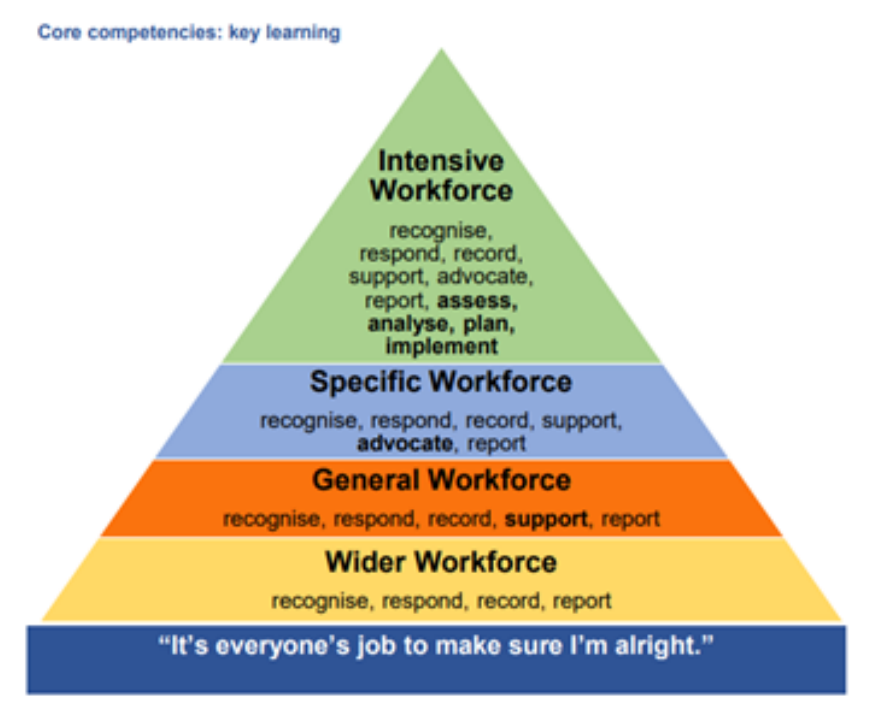
The Trustees are committed to on-going safeguarding training and development opportunities for all workers, developing a culture of awareness of safeguarding issues to help protect everyone. All our workers will receive induction training and undertake recognised safeguarding training on a regular basis. The Trustees will facilitate all staff/volunteers undertaking basic safeguarding training which will be renewed every three years. The Trustees will facilitate the Safeguarding Lead/Deputy Safeguarding Lead undertaking advanced safeguarding training which will be renewed every two years. Where possible, the Trustees will facilitate additional training for the requirements of the role. Further details of training requirements for safeguarding leads in Scotland can be found here: https://www.gov.scot/publications/national-framework-child-protection-learning-developmentscotland-2024
The Trustees will facilitate specialist safeguarding training for the governance board/board of trustees which will be renewed every three years. The Trustees will also ensure that children and adults with care and support needs are provided with information on where to get help and advice in relation to abuse, discrimination, bullying or any other matter where they have a concern.
Practice Guidelines
As a church working with children, young people and adults with care and support needs we wish to operate and promote good working practice. This will enable our workers and volunteers to run activities safely, develop good relationships and minimise the risk of potential harm or abuse and false or unfounded accusations.
We will have specific good practice guidelines for every activity we are involved in. Certain activities require specific forms, e.g. consent forms, risk assessments etc some of which can be found in appendix 5.
Management of Workers – Codes of Conduct
As Trustees we are committed to supporting all workers and volunteers and ensuring they receive support and supervision. All workers and volunteers have been issued with a code of conduct for supporting children, young people and adults with care and support needs, and will be given clear expectations about what is expected of them both within their role and outside of their role. They will also receive further training as necessary.
The code of conduct can be found in appendix 4.
The Whistleblowing policy is available on the church website or on ChurchSuite.
Policy created using the Thirtyone:eight Model Safeguarding Template
SECTION 4: PARTNERSHIP WORKING
The diversity of organisations and settings means there can be great variation in practice when it comes to safeguarding children, young people and adults with care and support needs. This can be because of cultural tradition, belief and religious practice or understanding, for example, of what constitutes abuse.
At present we do not work directly with or request services from any other organisation. Should that change in the future, we will have clear guidelines with regards to our expectations of those with whom we work in partnership, whether in the UK or not. We will discuss with all partners our safeguarding expectations and have a partnership agreement for safeguarding. It is also our expectation that any organisation using our premises, as part of the letting agreement will have their own policy that meets our safeguarding standards.
We believe good communication is essential in promoting safeguarding, both to those we wish to protect, to everyone involved in working with children and adults with care and support needs and to all those with whom we work in partnership. This safeguarding policy is just one means of promoting safeguarding.
Policy created using the Thirtyone:eight Model Safeguarding Template
SECTION 5: RESPONDING TO ALLEGATIONS OF ABUSE
Under no circumstances should a worker or volunteer carry out their own investigation into an allegation or suspicion of abuse.
Follow procedures as below:
The worker or volunteer should make a report of the concern in the following way:
The person in receipt of disclosures, allegation or concern of abuse should report concerns as soon as possible to:
Name: Clare Finbow (hereafter the "Safeguarding Lead")
Tel: 07503544614
Email: safeguarding@eastglasgow.church
The above is nominated by the Trustees to act on their behalf in dealing with the disclosure, allegation or concern, including referring the matter on to the statutory authorities.
In the absence of the Safeguarding Lead then the report should be made to:
Name: Rhona Latham (hereafter the "Deputy Safeguarding Lead")
Tel: n/a
Email: safeguarding@eastglasgow.church
If the concerns implicate either of or both the Safeguarding Lead and the Deputy Safeguarding Lead, then the report should be made in the first instance to:
Name: Oluwatobi Adeagbo (hereafter the “Safeguarding Trustee”)
Tel: 07765612018
Email: trustees@eastglasgow.church
The worker or volunteer can also contact Thirtyone:eight to get further advice if required: Tel: 0303 003 1111, option 2
The worker or volunteer should record the disclosure, allegation or concern onto the cause for concern form and share this with the Safeguarding Lead/Safeguarding Deputy or Safeguarding Trustee as soon as possible. Please see a copy of the cause for concern form in appendix 5.
The Safeguarding Lead may first ring the Thirtyone:eight helpline for advice. Based on the concern, they may then contact the relevant statutory services.
Glasgow City Health and Care Partnership
Children’s Social Services
Tel: 0141 287 0555
Out of hours Tel: 0300 343 1505.
Website Address: https://www.yoursupportglasgow.org
Adult Social Services
Tel: 0141 287 0555
Out of hours Tel: 0300 343 1505.
Website Address: https://www.yoursupportglasgow.org
Police Scotland
Tel: 101
The Safeguarding Lead may need to inform others depending on the circumstances and/or nature of the concern, such as:
Chair of Trustees or trustee responsible for safeguarding who may need to liaise with the insurance company or the charity regulator (Charity Commission for England and Wales, Charity Commission for Northern Ireland or Office of the Scottish Charity Regulator) to report a serious incident/raise a concern (Scotland).
Child’s Named Person (Scotland) if the allegation concerns a worker or volunteer working with someone under 18.
Concerns must not be discussed with anyone other than those nominated above. A written record of the concerns should be made in accordance with these procedures and kept in a secure place.
Whilst disclosures, allegations or concerns of abuse will normally be reported to the Safeguarding Lead, the absence of the Safeguarding Lead should not delay referral to the statutory services, the Police Scotland or taking advice from Thirtyone:eight.
The Trustees will support the Safeguarding Lead in their role and accept that any information they may have in their possession will be shared in a strictly limited way on a need-to-know basis.
It is, of course, the right of any individual as a citizen to make a direct referral to the safeguarding agencies or seek advice from Thirtyone:eight, although the Trustees hope that members of the organisation will use this procedure. If, however, the individual with the concern feels that the Safeguarding Lead has not responded appropriately, or where they have a disagreement with the Safeguarding Lead(s) as to the appropriateness of a referral they are free to contact an outside agency directly. We hope by making this statement that the Trustees demonstrate our commitment to effective safeguarding and the protection of all those who are vulnerable.
The role of the safeguarding Safeguarding Lead is to collate and clarify the precise details of the allegation or suspicion and pass this information on to statutory agencies who have a legal duty to investigate.
Detailed procedures where there is a concern about a child:
Allegations of physical injury, neglect or emotional abuse:
If a child has a physical injury, a symptom of neglect or where there are concerns about emotional abuse, the Safeguarding Lead will:
If the child requires immediate medical attention, contact the relevant medical services, informing the Doctor of any concerns.
Contact Children’s Social Care (England, Wales, Scotland), Gateway Services (Northern Ireland) (or Thirtyone:eight) for advice in cases of deliberate injury, if concerned about a child's safety or if a child is afraid to return home.
If the disclosure, allegation or concern is directly about the parents, then do not tell the parents or carers unless advised to do so, having contacted Children’s Social Care (England, Wales, Scotland), Gateway Services (Northern Ireland).
For lower-level concerns, (e.g. poor parenting), encourage parent/carer to seek help, but not if this places the child at risk of harm.
Where the parent/carer is unwilling to seek help, offer to accompany them. In cases of real concern, if they still fail to act, contact Children’s Social Care directly for advice.
Seek and follow advice given by Thirtyone:eight (who will confirm their advice in writing) if unsure whether to refer a case to Children’s Social Care (England, Wales, Scotland), Gateway Services (Northern Ireland).
Allegations of sexual abuse:
In the event of allegations or concerns of sexual abuse, the Safeguarding Lead will:
Contact the Children’s Social Care (England, Wales, Scotland), Gateway Services (Northern Ireland) for children and families and police, police Scotland or Police Service Northern Ireland (PSNI) on 101.
Depending on the circumstances, they will need to consider whether it is appropriate to speak to the parents of the child. If they are not sure about this, then they will contact Thirtyone:eight.
Seek and follow the advice given by Thirtyone:eight if for any reason they are unsure whether to contact Children’s Social Care (England, Wales, Scotland), Gateway Services (Northern Ireland)/police, police Scotland or Police Service Northern Ireland (PSNI). Thirtyone:eight will confirm its advice in writing for future reference.
Allegations of financial abuse:
In the event of allegations or concerns of financial abuse, the Safeguarding Lead/Deputy Safeguarding Lead will:
Contact Children’s Social Care (England, Wales, Scotland), Gateway Services (Northern Ireland) to report the concerns and the police, police Scotland or Police Service Northern Ireland (PSNI).
Detailed procedures where there is a concern about an adult at risk:
Concerns or allegations of abuse or harm including; physical, sexual, organisational, financial, discriminatory, neglect, self-neglect, forced marriage, modern slavery, domestic abuse. If there is concern about any of the above the Safeguarding Lead will:
If the adult is in immediate danger or has sustained a serious injury contact the Emergency Services on 999, informing them of any suspicions.
Contact Adult Social Care (England, Wales, Scotland) or Adult Social Work Services (Northern Ireland) who will be able to advise whether this reaches the safeguarding threshold and actions required. Alternatively, Thirtyone:eight can be contacted for advice.
If there is a concern regarding spiritual abuse against a child or adult at risk, Safeguarding Lead will:
Identify support services for the Survivor i.e., counselling or other pastoral support
Contact Thirtyone:eight and in discussion with them will consider appropriate action with regards to the scale of the concern.
Allegations of abuse against a person who works with children/young people:
If an accusation is made against a worker (whether a volunteer or paid member of staff) whilst following the procedure outlined above, the Safeguarding Lead will:
Make a referral to the Local Authority Designated Officer -LADO(England and Wales), Child’s Named Person (Scotland) or the Gateway Team (Northern Ireland) whose function is to handle all allegations against adults who work with children and young people whether in a paid or voluntary capacity.
Make a referral to the relevant Disclosure and Barring Service (DBS (England and Wales), Disclosure Scotland (Scotland) or AccessNI (Northern Ireland) for consideration of the person being placed on the barred list for working with children or adults with care and support needs. This decision should be informed by the Local Authority Designated Officer (England and Wales), Children’s Social Care (Scotland) or the Gateway Team (Northern Ireland) if they are involved.
Share information about the concern with the police, police Scotland or Police Service Northern Ireland (PSNI).
Allegations of abuse against a person who works with adults with care and support needs:
The Safeguarding Lead will:
Liaise with Adult Social Care (England, Wales, Scotland) or Adult Social Work Services (Northern Ireland) to establish whether this can be investigated under their safeguarding processes.
Make a referral to the relevant Disclosure and Barring Service DBS (England and Wales), Disclosure Scotland (Scotland) or AccessNI (Northern Ireland) following the advice of Adult Social Services.
Share information about the concern with the police, police, police Scotland or Police Service Northern Ireland (PSNI).
The legislation across all four UK nations (The Care Act 2014, Adult Support and Protection (Scotland) Act 2007, Adult Safeguarding: Prevention and Protection in Partnership key documents 2015 (Northern Ireland) and Social Services and Wellbeing (Wales) Act 2014) places the duty upon Adult Social Care to investigate situations of harm to adults with care and support needs. This may result in a range of options including action against the person or organisation causing the harm, increasing the support for the carers or no further action if the ‘victim’ chooses for no further action and they have the capacity to communicate their decision. However, this is a decision for Adult Social Care to decide not the organisation.
Allegations of non-recent sexual abuse:
If an accusation is made of non-recent sexual abuse from a child, the procedure in relation to sexual abuse will be followed (please see above).
If an accusation is made of non-recent sexual abuse from an adult, the Safeguarding Lead will:
Give the adult the option to report this to the Police (England and Wales), Police Scotland or Police Service Northern Ireland (PSNI). If the adult does not wish to report this to the police, then the Safeguarding Lead can pass on the information relating to the alleged Perpetrator, however, must not share details of the Survivor.
If the alleged Perpetrator is in a role working or volunteering with children or young people, make a referral to the Local Authority Designated Officer -LADO(England and Wales), Children’s Social Care (Scotland) or the Gateway Team (Northern Ireland) whose function is to handle all allegations against adults who work with children and young people whether in a paid or voluntary capacity.
If the alleged Perpetrator is in a role working with adults with care and support needs, liaise with Adult Social Care (England, Wales, Scotland) or Adult Social Work Services (Northern Ireland) to establish whether this can be investigated under their safeguarding processes.
If the alleged Perpetrator is in a role within your organisation, contact Thirtyone:eight and in discussion with them will consider appropriate action with regards to the scale of the concern.
Policy created using the Thirtyone:eight Model Safeguarding Template
SECTION 6 WELLBEING SUPPORT AND PASTORAL CARE SUPPPORTING THOSE AFFECTED BY ABUSE
The Trustees are committed to offering wellbeing support/pastoral care, working with statutory agencies as appropriate, and support to all those who have been affected by abuse who have contact with or are part of EAST.
Please see below the details for the individual responsible for wellbeing support/pastoral care:
Name: Tim Scoular (Lead Pastor)
Tel: 07355895073
Email: tim@eastglasgow.church
Working with those who may pose a risk
When someone attending the organisation is known to pose a potential risk to children, or adults with care and support needs; the Trustees will ensure there is appropriate supervision of the individual concerned and accessible wellbeing support/pastoral care, however, in our safeguarding commitment to the protection of children and adults with care and support needs, we will set boundaries for that person, which they will be expected to keep. These boundaries will be based on a risk assessment and through consultation with appropriate external parties.
Adoption of the policy
This policy was agreed by the Trustees and will be reviewed annually on: 26/01/2026 Signed by:
Oluwatobi Adeagbo
Position: Chair of Board of Trustees
Signed by: Tim Scoular
Position: Lead Pastor
Date: 26/01/2026
Policy created using the Thirtyone:eight Model Safeguarding Template
Documents referred to as appendix items are available upon request